
 Project request


Remote work—do you remember how it used to be perceived? At one time, remote jobs simply meant working from home. But by 2025, this concept has completely transformed. Now, from small companies to large enterprises, businesses are not only saving costs by hiring remote teams but also gaining access to skilled professionals. For example, a large remote team from Asia can now be efficiently managed from the United States with ease. Remote work has become the most effective working arrangement for achieving optimal output. As companies aim to expand capacity, they first look for their local talent. But it is never simple to get the right person on time. Yes, scaling a remote team isn’t as simple as it seems. Hiring a bunch of the best people across time zones takes intention, structure, and a lot of trust.
Here you will be guided to explore some practical ways to scale your operations using global remote teams. You will know the strategies for hiring a remote team, fostering communication, building culture, and maintaining productivity. You’ll get clear insights to help your startup grow and leverage a worldwide remote workforce.
What Does a “Scalable Remote Team” Even Mean?
Just imagine that you are building something with Lego. Started with a few blocks, just enough to create the base. As the idea grows, you keep adding more pieces. Each one clicks into place because the design allows it. No need to rebuild—expand.
A scalable remote team works the same way. You begin with a strong foundation: clear roles, solid tools, and shared goals. Then, as new people join, they fit right in. The structure holds. The vision grows. And the build never breaks.

The Rise of Global Remote Teams in Startups
Startups mostly can’t afford or are unable to hire people from outside of the city. Now, it has become easier with Slack, Zoom, and other tools; your hiring is as easy as walking to your next door. From São Paulo to Toronto, you can hire the best candidate in hours. Now, any small startup can compete with big companies on a level playing field. Any small company can access the same global talent pool.
Why More Businesses Are Going Remote
Startups around the world are constantly striving to maintain a balance in competitive markets while working within limited budgets. Therefore, alongside skill development, they are continuously updating their work methods to increase success and growth.
On the other hand, large businesses, when extending their teams, are gradually expanding their operations by creating remote extensions instead of setting up new physical offices.
One of the most effective ways to compete with the competitive salaries of big companies and hire skilled professionals is through remote hiring.
At present, the IT sector ranks second among global industries. Thus, one of the most efficient ways to leverage this vast workforce is by building a well-structured remote team.
At present, the IT sector ranks second among global industries. Thus, one of the most efficient ways to leverage this vast workforce is by building a well-structured remote team.
Various e-commerce, social media, and large enterprise businesses aim to recruit experienced professionals quickly. In the United States, hiring remote teams from any Asian country has now gained significant popularity.
This approach not only helps startups reduce costs but also enables them to build and manage skilled teams effectively.

Hiring the Right Remote Talent
The most important part is that remote work is not for every business. Remote work is suitable for those who are not only looking for skills but also can manage their own time, communicate simultaneously, and stay motivated without depending on others.
A few ways to make every hire in your favor:
Be clear about your role expectations when you hire.
Look for culture fit just as much as technical skill.
Testing with a small project shows how someone really works.
Without limiting yourself to the market, hire the best people across the world.

Building a Strong Remote Culture
When your team is spread out, you have to make an effort to connect people to celebrate wins because culture doesn't just happen. Encourage the team for casual chats and build traditions. It could be as simple as "Friday wins" in Slack or a monthly virtual coffee.
Building maximum community engagement with tools like Donut(Slack integration), Gather, or Discord for remote bonding. Little things like this make teams feel like a family rather than just a name on Zoom.
Communicating Without Burning Out
If there is no good communication, working remotely can become counterproductive.
For this reason, some ground rules must be applied to overcome these issues-
Small problems can be solved through the use of various chat tools.
Information discussed can be saved through video call recordings.
After writing down all the information, it should be documented for future use.
And we should always remember that more communication is almost always better than less.

Working Across Time Zones
Without proper management, working across different time zones may seem like a difficult task. However, with the right planning, it is possible to manage the entire team even if everyone is not online at the same time.
Tasks should be scheduled during the hours when most employees are online. If someone is not available, they can stay updated through team videos, meeting notes, and effective use of project management software. By sharing essential updates and files through asynchronous tools like World Time Buddy, Notion, or Loom. In this way, work progress will never be missed—even if half of the team is asleep.
Productivity Without Micromanagement
No one wants their work to be controlled by others, especially in remote settings. So, what is the right approach? It is to provide people with sufficient time and complete independence to achieve agreement on work outcomes. By making everyone’s progress visible through various boards such as OKRs, project boards, or dashboards, accountability and transparency in work can be ensured. Desired results cannot be achieved merely through check-in and check-out systems. Therefore, in remote work, it is essential to allow freedom in research and make work progress visible to everyone.
The Not-So-Fun Part: Legal & Financial
Hiring people from different countries, sending contracts, and starting to pay them is not as easy as it seems. There are various country-specific rules, employment laws, tax regulations, and compliance requirements. If you hire in the wrong way, then you could face fines, legal trouble, or delays.
So, give it to them to handle everything for you.
Here, Employer of Record (EOR) and global payroll platforms come in to do it for you:
Employer of Record (EOR)
They become the official employer of your worker on paper where your worker lives.
Handles all the legal and HR admin documentation:
Drafting employment contracts
Registering with local tax authorities
Ensure local labour laws, etc.
You can manage your employees for day-to-day work. But you won’t worry about any legal issues, and there's no need to set up your own company in that country.
So, it’s now easier to expand into a new country quickly, test a market, or hire remote talent without creating a local entity.
Global Payroll Platforms
With the help of this platform, paying people in multiple countries becomes easier. By centralizing payroll, paying everyone from one place in their local currency is more friendly. Calculating every accounting, like taxes, deductions, and benefits, according to each country's rules. Payslip generation, report handling, and integration with other accounting tools under one roof.
It is best for the companies that already have legal entities in the countries where they hire, but want to simplify payroll operations.

Keeping Innovations & Discovery Alive
Some people worry that remote teams kill creativity. However, the truth is that to achieve the best innovation, you simply need the right setup. Virtual whiteboards, brainstorm sessions, hack weeks, or even async idea boards can spark creativity in your team.
The most important part is here to give people the chance to share their knowledge and half-baked ideas in a safe and encouraging environment. That’s where the good stuff usually starts.
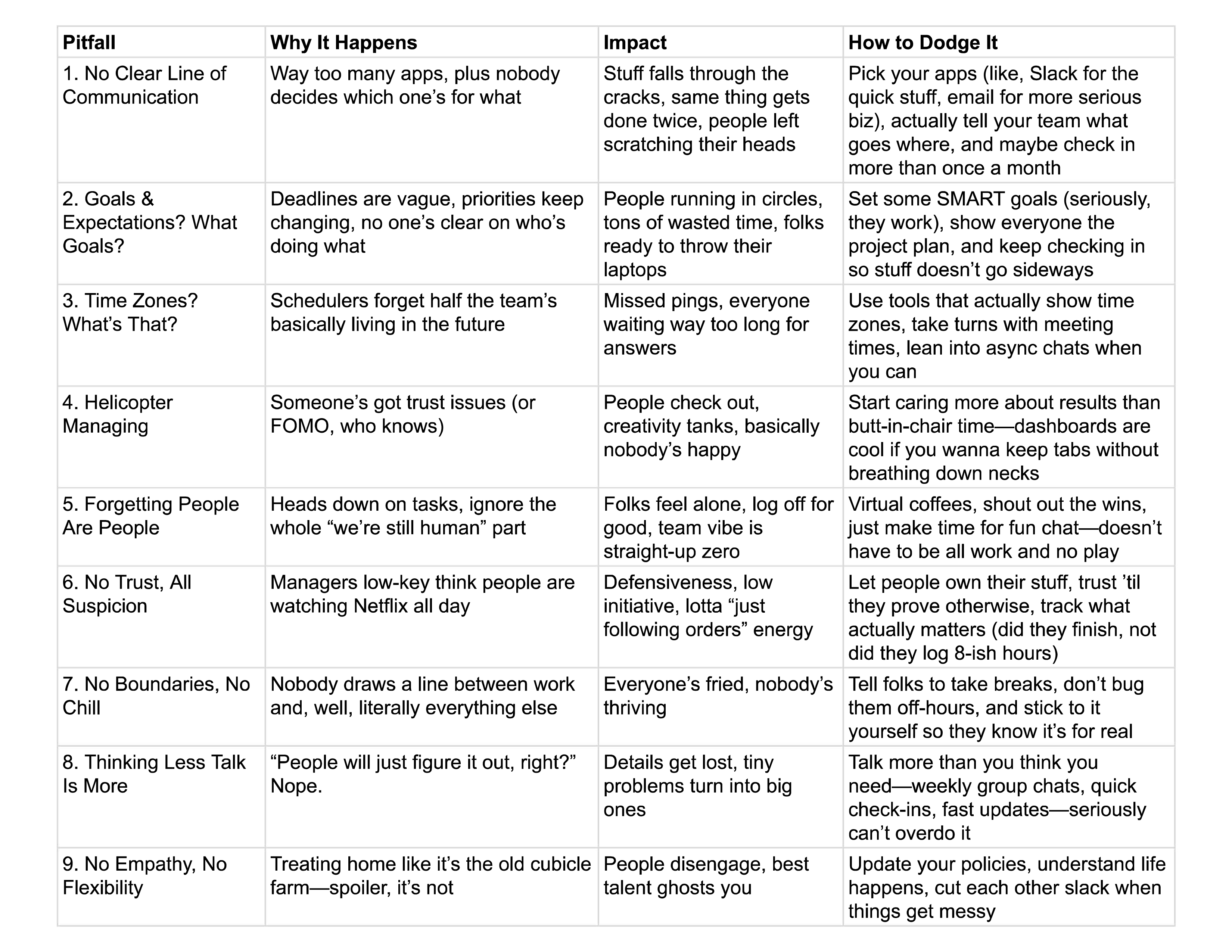
The Common Pitfalls of Remote Teams
Every remote team has some common bumps. Let’s discuss it.
Knowing When It’s Time to Scale
How do you know when to start growing your team? A few signs:
Your current crew is stretched thin.
Customers are piling up faster than you can serve them.
You need skills your team doesn’t have yet.
You’re ready to explore new markets.
If you’re nodding along, it’s probably time.
The Takeaway: You Don’t Have to Do It Alone
Scaling a remote team isn’t easy—but it also doesn’t have to be lonely. Learn from other founders, lean on the growing list of remote-work tools, and don’t be afraid to ask for help.
Your dream team could be anywhere in the world. The only question is: are you ready to find them?
👉 If you’re thinking about scaling your remote team, start small, be intentional, and remember—done right, remote isn’t a limitation. It’s your superpower.
Book a free consultation: https://zentexx.com/book-meeting